
Questions About Propane?WE CAN HELP
FAQS
Residential FAQ
Residential Propane Services
Frequently Asked Questions (FAQ)
Getting Started: Propane Basics
What is propane and how is it used in homes?
Propane (C₃H₈) is a clean-burning fuel stored as a liquid and used for heating, water heating, cooking, fireplaces, dryers, and standby generators. Many rural homes choose propane where natural gas isn’t available.
How many BTUs are in a gallon of propane?
About 91,452 BTU per gallon (higher heating value), useful for estimating usage and comparing fuels.
What does propane smell like?
Like rotten eggs or skunk—thanks to the odorant ethyl mercaptan added for safety. If you suspect a leak, leave immediately and call your propane supplier or 911 from a safe place.
Does propane “go bad”?
No—propane is stable; it doesn’t degrade like gasoline or diesel. Cold weather can reduce tank pressure (not quality), which can affect appliance operation until pressure recovers.
How do I choose the right company?
Look for 24/7 support, transparent pricing, automatic delivery options, safety expertise, and local service.
Can I switch to Corrigan from another provider?
Yes. We handle the tank set or transfer, safety checks, and first fill, coordinating timing so you don’t run out.
Tank Sizes & How Much You Need
What tank sizes are common for homes?
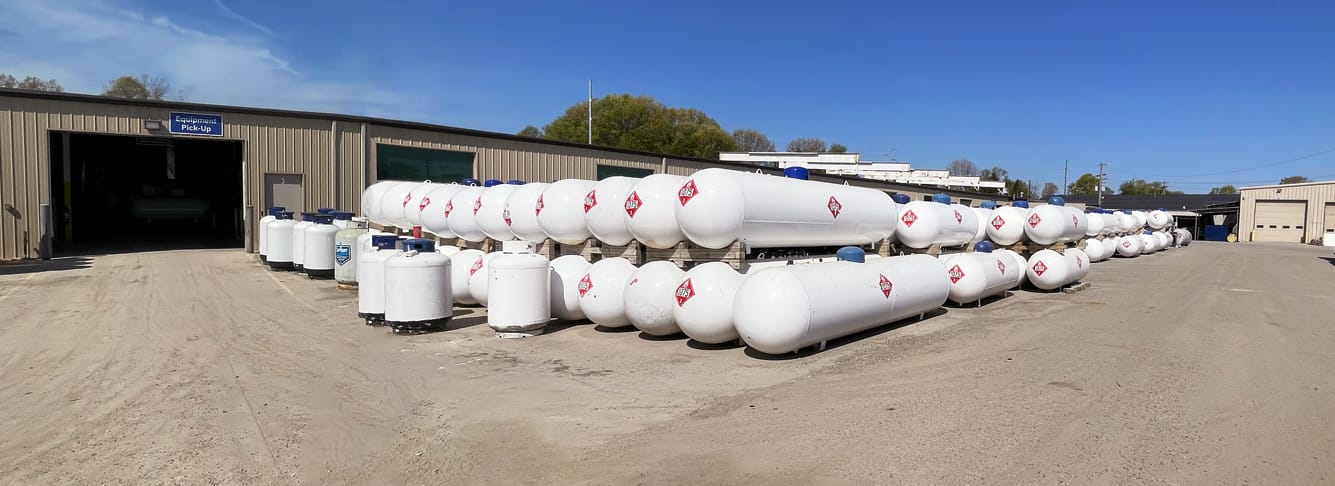
Typical residential sizes are 120, 250, 325, 500, and 1,000 gallons. Many homes with whole-home heat use 500-gallon tanks. Your appliance mix and usage determine the best size.
How do I estimate the right tank size?
We consider square footage, insulation, number of propane appliances, hot-water demand, generator size, and your delivery preference (auto vs. will-call).
How long will a tank last?
It depends on weather and usage. A rough method is to total appliance BTUs, estimate daily runtime, and divide by 91,452 BTU/gal. We’re happy to calculate for you.
What’s the difference between tank capacity and “usable gallons”?
Tanks are filled to about 80% to allow for expansion; a 500-gallon tank typically holds ~400 gallons when “full.”
Can I add a second tank?
Yes—multi-tank manifolds can extend capacity for large loads (pools, whole-home generators) without a single larger tank.
Do small cylinders (grills) work with home systems?
No. Home systems use ASME stationary tanks with regulators and fixed piping. DOT cylinders are for portable uses and follow different rules, including periodic requalification.
Will a 500-gallon tank fit my property?
A 500-gallon above-ground tank is roughly 10′ long; placements must meet code clearances, site access, and aesthetic preferences. Your Corrigan tech will verify on-site.
Ownership, Leasing & Installation
Should I lease or own my tank?
Leasing lowers upfront cost and includes service from your supplier.
What happens during installation?
We plan the location, set the tank, install regulators/piping, leak-check, and light appliances per NFPA 54/58 and local code.
How long does a tank last?
Stationary ASME tanks are durable for decades with proper installation and corrosion protection; periodic inspections are part of safe operation.
Who handles permits?
Corrigan coordinates required permits/inspections based on local authority.
What’s included in a new-customer setup?
Safety inspection, regulator checks, system test, first fill, delivery setup, and an overview of gauges, valves, and emergency procedures.
Underground vs. Above-Ground Tanks
Do underground tanks cost more?
They typically cost more to install (excavation, anodes/cathodic systems) but may satisfy HOA or aesthetic preferences.
Can I landscape around an above-ground tank?
Yes—maintain clearances and keep valves, gauges, and delivery access unobstructed.
Do codes differ for underground vs. above-ground?
Clearance, setback, and protection requirements vary; we follow NFPA 58 and local code.
Pricing, Plans & Programs
What is a pre-buy plan?
Purchase gallons ahead of the season at a fixed rate; deliveries draw from your prepaid balance.
What is a price-lock plan?
Lock a fixed per-gallon rate for the season; pay as you receive deliveries.
What is a price-cap plan?
You’ll never pay above the cap but may pay lower if market prices fall.
What is budget billing?
We estimate your annual usage and spread it into 12 predictable monthly payments, with periodic reviews.
Do auto-fill customers get better pricing?
Auto-Fill often includes reduced rates due to delivery efficiency—ask about current discounts.
Safety & Emergencies
I smell gas—what should I do?
No flames or sparks; leave immediately; if safe, close the tank valve; call us or 911 from a neighbor’s phone; don’t re-enter until cleared by a professional.
Do I need carbon monoxide (CO) alarms?
Yes—install CO alarms on every level and outside sleeping areas; follow the manufacturer’s instructions and test regularly.
Where should CO alarms be placed?
Each floor and near bedrooms; follow the device instructions (some are wall plug-in, some ceiling). Avoid vents and humid areas.
What’s the difference between a CO alarm and a gas detector?
CO alarms sense carbon monoxide from improper combustion. Combustible gas detectors sense unburned fuel gas—both are useful and should be listed devices.
What causes CO issues?
Improper venting, blocked flues, or malfunctioning appliances. Have systems inspected annually and keep vents clear of snow/ice.
Can I relight my pilot?
Only if the manufacturer’s instructions allow and you’re comfortable; otherwise call us. If you smell gas, don’t attempt it.
Is propane toxic?
Propane is non-toxic, but high concentrations displace oxygen. Always follow leak-response steps and ventilate.
Should I shovel around my tank/regulator in winter?
Yes—keep tank, regulators, piping, and vents clear; heavy snow/ice can damage components or block combustion air.
Are portable cylinders subject to requalification?
Yes—DOT cylinders must be periodically requalified; check the dates stamped on the collar.
Winter, Weather & Outages
Will propane freeze?
Propane itself doesn’t freeze in normal winter conditions, but pressure drops in extreme cold can affect flow. Keeping adequate levels and wind protection helps.
How do I avoid winter run-outs?
Enroll in Auto-Fill or use a smart monitor, order at ~30%, and clear access for the truck.
Can snow affect appliance safety?
Yes—snow/ice can block vents and create high CO risk. Keep vents and regulators clear.
Do you deliver during heavy snow?
We do everything possible; please plow/mark the driveway and tank so we can reach it safely.
Do wind chill or cold snaps change delivery timing?
Yes—our forecasting advances routes during extreme cold.
Moving, Buying & Selling Propane Home
Selling my home—what happens to the tank and fuel?
Leased tanks generally stay and transfer; owned tanks can be included in the sale. We provide final readings and fuel valuation for closing.
Buying a home with propane—what should I do first?
Open an account before/at closing, request a safety check, confirm remaining fuel, and choose delivery/payment options.
Can Corrigan orient the new homeowner?
Yes—our Welcome Visit covers reading the gauge, safety basics, and appliance overview.
Moving out of the area?
We’ll settle your account, coordinate tank pickup/transfer, and help the next owner continue service.
New construction—when is the best time to plan propane?
Early! We coordinate trenching, regulators, and appliance specs with your builder to pass inspections smoothly.
Regulations, Codes & Compliance
Which codes govern propane use in homes?
The two primary codes are NFPA 58 (Liquefied Petroleum Gas Code) and NFPA 54 (National Fuel Gas Code).
- NFPA 58 regulates the storage, handling, transportation, and installation of propane tanks and cylinders. It covers requirements for above-ground and underground propane tanks, separation distances, valves, regulators, and safety equipment.
NFPA 54 applies to propane and natural gas appliances inside the home, such as furnaces, water heaters, stoves, and fireplaces. It governs venting, combustion air, piping, and appliance installation standards.
Most states adopt these codes (sometimes with modifications) as part of their building and fire codes. Local inspectors enforce compliance during new installations, renovations, or safety inspections.
Do propane tanks and systems need to be inspected by law?
Yes. Periodic inspections are required under NFPA 58 and enforced by state or local authorities. Inspections typically cover:
- Tank integrity and corrosion protection (especially for underground tanks)
- Regulator function and replacement intervals (usually every 15 years or sooner)
- Piping, valves, and connectors for leaks or damage
- Clearance distances from structures, ignition sources, and property lines
Your propane supplier is responsible for performing leak checks and system inspections when installing tanks, after running out of gas, or whenever new equipment is connected. Homeowners should expect safety checks at installation and may be required during refills, depending on state law
Do I need a permit to install or move a propane tank?
In most jurisdictions, yes. Installing or relocating a propane tank usually requires a permit from the local building or fire department. The permit ensures:
- The tank is sized correctly and placed according to NFPA 58
- Proper clearances from structures and property lines are observed
- Piping, regulators, and appliances meet code standards
- The installation passes inspection before use
Your propane company typically handles the permitting process on your behalf, but homeowners should be aware that installation without a permit can result in fines or forced removal.
Who enforces propane codes and regulations?
Enforcement depends on jurisdiction. Common authorities include:
- State Fire Marshal’s Office – Often oversees propane system compliance statewide
- Local Fire Departments – Inspect residential tank placement and safety
- Building Inspectors – Review installation of gas piping and appliances
- Propane Suppliers – Must follow federal, state, and NFPA standards to maintain licenses
Ultimately, homeowners are responsible for ensuring their property complies, but propane companies and inspectors share accountability for safe installation and operation.
Commercial FAQ
Commercial Propane Services
Frequently Asked Questions (FAQ)
Getting Started & Commercial Account Setup
What areas does Corrigan Propane serve for commercial accounts?
We serve businesses across Michigan, Ohio, and Indiana, with local teams for delivery, installation, and support. If you’re just outside those areas, contact us—we can often coordinate service or a referral.
How do I open a commercial account?
Call or request a quote online. We’ll confirm your site details, usage profile (seasonal or year-round), safety needs, and billing preferences, then schedule a site visit for sizing and placement.
How quickly can you start service?
Most new installs begin after a short site assessment, equipment scheduling, and any required permits. If you have an urgent need, we’ll prioritize delivery and temporary solutions to keep you running.
Do you handle permits and inspections?
Yes. We coordinate permitting, installation documentation, and work with Authorities Having Jurisdiction (AHJs) to ensure your setup meets applicable NFPA 58/IFC/OSHA expectations.
Can you work with our general contractor or facilities team?
Absolutely. We regularly coordinate with builders, property managers, and safety officers to align propane system design with your project timeline.
Do you offer equipment leasing as well as customer-owned options?
Yes. We offer flexible lease or purchase options and will recommend the best fit based on usage, cash flow, and operational goals.
Do you provide references or case studies?
Yes—across warehousing, agriculture, hospitality, construction, and retail. Ask us for examples relevant to your operation size and seasonality.
What insurance and certifications do your teams carry?
Our drivers and technicians hold required certifications and complete ongoing training; Corrigan maintains appropriate insurance and follows DOT, OSHA, and NFPA standards for commercial propane work.
Supply & Delivery Logistics
How do scheduled deliveries work?
We set routes around your usage and seasonality. Many customers use remote tank monitoring so deliveries are timed before you run low—no guesswork.
What is “will-call” delivery vs. automatic delivery?
Will-call means you order when you’re low; automatic uses usage history and tank monitors to plan deliveries for you. Automatic is popular for high-demand sites.
Do you offer 24/7 emergency delivery?
Yes—seasonal peaks, cold snaps, or outages happen. We provide after-hours dispatch and emergency delivery in our service area (fees may apply).
What minimum tank percentage should I reorder at?
Most commercial users call around 20–30%. With monitors, we’ll schedule drops before critical levels based on real-time data and your consumption pattern.
How much energy is in a gallon of propane?
About 91,500 BTU per gallon, helpful for estimating heater sizing and runtime.
Can you deliver to multiple sites under one account?
Yes. We consolidate billing and reporting across locations and can roll up usage by facility, cost center, or job code.
Do you offer seasonal ramp-ups (e.g., harvest or winter projects)?
We do—especially for grain drying, construction heat, and peak hospitality periods. We’ll increase drops and capacity temporarily, then scale back.
What are typical lead times in peak season?
Lead times vary by weather and demand. Monitoring and pre-season planning ensure priority service when conditions tighten.
Can Corrigan coordinate inside-the-fence logistics on large sites?
Yes—multiple tanks, long line runs, barricading, and safe traffic patterns are part of our standard commercial planning.
Tank Sizing, Placement & Equipment
How do you size a propane tank for my facility?
We model your BTU load (process heat, HVAC, forklifts, dryers, etc.), required runtime, and refill cadence. We’ll right-size for safety, uptime, and cost.
Where can tanks be placed?
Placement must comply with NFPA 58 and local fire codes (clearances, ignition sources, ventilation, access for filling). We’ll design and install to code and coordinate AHJ approvals.
Do you install multiple tanks manifolded together?
Yes—common for large facilities and long runs. Manifolding improves capacity and refill flexibility.
Do you provide vaporizer systems if needed?
Most commercial users call around 20–30For high instantaneous demand or cold conditions, we can spec vaporizers and regulators sized for your load.%. With monitors, we’ll schedule drops before critical levels based on real-time data and your consumption pattern.
How are relief valves and venting handled?
Relief devices must discharge safely (e.g., vertical discharge and protection for underground installations per OSHA sections). We design and install per code.
Can you add tank monitors to existing tanks?
Yes—most existing ASME and DOT vessels can be monitored with our telemetry for usage, alerts, and delivery timing.
Safety & Compliance (General)
What standards apply to commercial propane?
Primarily NFPA 58 (LP-Gas Code), applicable sections of the International Fire Code, and OSHA 1910.110 for storage/handling. Local rules may add requirements; we coordinate with your AHJ.
What is an OPD (Overfill Prevention Device) and do we need it?
An OPD helps prevent overfilling. NFPA 58 requires OPDs on cylinders from 4 to 40 lb capacity per specified dates; Corrigan cylinders comply.
How often must cylinders be requalified?
DOT 4-series cylinders must be requalified on a schedule (often 10–12 years from manufacture, then at intervals depending on the test method); overdue cylinders must not be refilled. Corrigan manages requalification on exchange inventory.
Can you advise us on indoor cylinder storage limits?
OSHA restricts how much LP-gas can be stored indoors and requires separation from exits/egress. We recommend outdoor cages.
What about training for our staff?
We provide propane safety orientations—handling, leak response, cylinder change-outs, and emergency contacts—aligned with OSHA/NFPA practices.
What should employees do if they smell gas?
Stop operations, evacuate to a safe distance, avoid ignition sources, and call Corrigan and emergency services. Do not operate switches or phones near a suspected leak.
Commercial Cylinder Exchange Program
How does Corrigan’s cylinder exchange work?
We install secure, ventilated cages, deliver certified full cylinders, and collect empties on a set route—so you always have fuel, no on-site filling required.
How often do you service the cages?
We tailor the route to your usage and seasonality, adding service during peaks so you don’t run out.
Are the cylinders inspected?
Yes—each cylinder is leak-tested, certified and labeled. Damaged/expired cylinders are pulled from circulation (OPD and requalification compliance).
Is exchange more expensive than refilling?
Refilling can be cheaper per pound, but when you factor labor, downtime, safety oversight, and equipment costs, exchange often has a lower total cost of ownership for busy sites.
Do you provide training for safe cylinder handling?
Yes—change-out, transport, storage, and emergency steps. We can refresh training for new staff or seasonal teams.
Can cages be placed indoors?
Exchange cages are placed outdoors and ventilated and must follow placement rules (clearances from doors/dispensers/combustibles) under NFPA/IFC and local rules.
How are cylinders secured against theft or tampering?
Lockable steel cages with ventilation and clear signage are standard; we also advise on lighting and cameras.
Do you recycle old cylinders?
Yes—Corrigan refurbishes or responsibly recycles cylinders that fail inspection, reducing waste and risk.
Can you service multiple cages across a campus or region?
Absolutely. We map routes across your locations and roll usage into consolidated billing.
What happens if we suddenly use more than planned?
Call us and we’ll arrange an off-cycle swap.
Do exchange cages require a fire extinguisher nearby?
Yes—expect a compliant extinguisher within a specified travel distance; we’ll specify type/placement with the AHJ.
Forklifts & Industrial Equipment
What propane cylinders do forklifts use?
Most use horizontal 33-lb liquid-withdrawal cylinders; other sizes exist depending on truck model. We’ll match your fleet’s spec.
How should a forklift cylinder be oriented on the truck?
With the pressure relief valve “up” (often the 12-o’clock position) so it’s in the vapor space; this is a common safety best practice in industry guidance.
Are forklift fuel containers subject to DOT rules?
Yes—industrial truck containers must meet DOT/ASME design pressures and be maintained accordingly.
What about indoor air quality?
Well-maintained propane engines and proper ventilation reduce CO risk; we recommend routine maintenance and CO monitoring per your safety plan.
Can Corrigan help right-size forklift cylinder inventory?
Yes—by tracking swaps per shift and peak usage, we’ll set an inventory that avoids stockouts without over-holding.
Do you service mixed fleets (propane + electric)?
We do—we’ll tailor cylinder counts and delivery frequency around your actual propane truck hours.
Builders & Construction Heat
What construction tasks is propane heat used for?
Concrete curing, drywall finishing, painting, roofing, and ground thawing—propane’s portability and high heat output make it ideal for dynamic sites.
Do you provide temorary heat packages?
Yes—tanks, manifolds, high-BTU heaters, hoses, regulators, airflow planning, and on-call deliveries.
Are there specific OSHA rules for temporary heat?
Yes—heater placement, separation from containers, ventilation, and fire safety are covered in OSHA 1910.110; we install to meet these requirements.
Can you deliver daily during cold snaps?
Yes—our dispatch scales routes during weather events to keep your timeline intact.
Do you provide jobsite safety briefings?
Yes—heater operation, barricades, hose routing, hot-work coordination, emergency procedures, and shutoff locations.
Agriculture & Grain Drying
Do you support both batch and continuous-flow dryers?
Yes—we support all major dryer configurations and help size tanks and vaporizers for peak demand.
Can I lock in propane costs before harvest?
We offer pre-buy and budget plans to stabilize costs when demand spikes.
Do you deliver diesel/gasoline and lubricants, too?
Yes—many farms prefer Corrigan’s multi-company services for simpler scheduling and fewer vendors.
Do you size heating for livestock barns and greenhouses?
We do.
Dispensing Stations & Retail
What is propane dispensing station?
A turnkey on-site filling system that lets your business fill customer cylinders/RV tanks. It drives traffic, adds revenue, and keeps your customers coming back.
Who is a good candidate?
Hardware stores, marinas, gas stations, campgrounds, RV parks, and retailers with steady local demand.
What does Corrigan provide?
Design, permitting, installation, operator training and ongoing propane supply.
Are there special safety requirements for exchange/dispense areas?
Yes—NFPA 58/IFC regulates cabinet location, ventilation, separation from doors/dispensers, and extinguisher placement. We site and document per code.
Do attendants require training?
Yes—operators must be trained on safe filling, inspections, emergency shutoff, and incident response; we provide this training.
How quickly can a station go live?
Timeline depends on local permitting and utility coordination; our team manages the process end-to-end.
Can we combine exchange cages with a dispensing station?
Many retailers do—serving both “swap” and “refill” customers to maximize volume.
Monitoring, Technology & Data
What is remote tank monitoring?
A low-power device tracks liquid level and usage, alerting us (and optionally you) so deliveries are automatically scheduled before you run low.
Does monitoring reduce delivery costs?
It reduces emergency calls, “just-in-case” drops, and runouts, boosting uptime.
Can we see our data?
Yes—usage history, fill events, and alert thresholds can be shared with your facilities or procurement team.
Can monitoring be added to customer-owned tanks?
In most cases, yes. We’ll assess access, compatibility, and mounting options.
Pricing, Contracts & Billing
How is commercial propane priced?
Price reflects market conditions, delivery cadence, volume, and contracted terms. We offer pricing options.
Do you offer budget billing or pre-buy?
Yes—budget plans smooth cash flow; pre-buy locks in fuel volume at set pricing during peak seasons (popular for dryers and winter heat).
Are there minimum usage requirements?
Some equipment leases or station installs include throughput expectations—discussed up front and tailored to your operation.
Can you consolidate invoices across locations?
Yes. We support roll-ups by site, region, or business unit, with usage analytics to support budgeting.
Do you charge hazmat or tank fees?
Any fees are disclosed up front—no surprises.
Emergency, Training & Support
What should we do during a suspected leak?
Evacuate, avoid flames/sparks, don’t operate electrical switches, and call Corrigan and emergency services.
Do you offer 24/7 emergency response?
Yes—leaks, outages, or urgent refills. We’ll dispatch qualified techs and coordinate with responders as needed.
How often should we refresh training?
At least annually and whenever job duties change, equipment is updated, or a safety incident occurs.
What sets Corrigan apart when things don’t go as planned?
Local teams, 67+ years of experience, 24/7 support, remote monitoring, and turnkey compliance—we’re on the ground with you to keep operations safe and on schedule.